Real-time SSL certificate alerts
Get paged the moment a certificate enters the danger zone — on the channel your team actually watches. Staged thresholds at 30, 14, 7 and 1 day give you time to act at each level of urgency.
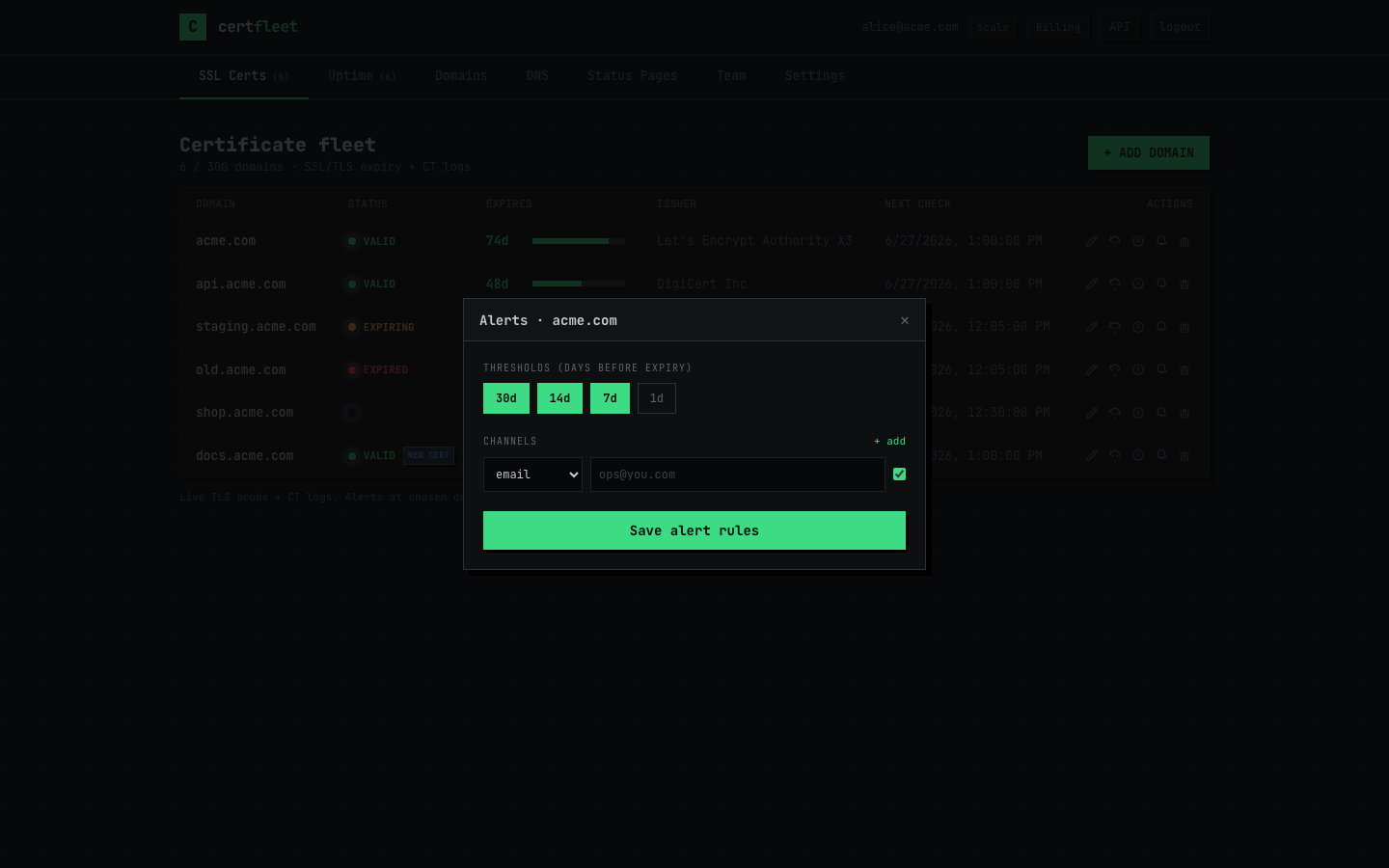
Per-certificate alert configuration — choose thresholds and channels independently for each domain. Each threshold fires exactly once: one notification at 30d, one at 14d, one at 7d, one at 1d.
An SSL certificate that expires silently takes your site, API, or internal tool offline the moment a browser tries to connect. The browser shows a full-screen security error — not a slow page, not a partial failure, a complete block. Getting an alert 30 days before expiry rather than on expiry day is the difference between a planned renewal during business hours and an emergency page to on-call at midnight. SSL certificate alerts exist to make that window visible before it closes.
The four alert thresholds correspond to four different required actions. At 30 days: verify that auto-renewal is configured, the ACME challenge will succeed, and the payment method for a commercial CA is valid. At 14 days: if auto-renewal has not run, initiate a manual renewal now — there is still time for a normal change management process. At 7 days: a renewal that has not happened is now urgent; escalate immediately and start a manual renewal today. At 1 day: emergency — someone needs to act within hours or production will go down. Without staged thresholds, a single alert arrives when the cert is already expired, at which point every option is urgent.
Idempotent alert delivery is a design requirement, not an optimization. A monitoring system that fires one alert per check cycle — checking every 5 minutes and sending 288 "your cert expires in 3 days" emails per day — trains on-call engineers to ignore the monitoring system. CertFleet fires exactly one alert per threshold crossing per certificate. When the 14-day threshold is crossed, one notification is sent. When the 7-day threshold is crossed, one notification is sent. Recovery does not re-trigger expired thresholds. Each crossing is independent and fires once.
Alert channels are configured per certificate. Email is the baseline and always available on the free tier. A dedicated Slack channel routes cert alerts to the infrastructure team without spamming general channels. HMAC-signed webhooks (Starter plan and above) deliver a structured JSON payload to any receiver: PagerDuty, Opsgenie, a custom AWS Lambda, or a Slack incoming webhook with custom formatting. The webhook payload includes the certificate serial, expiry date, days remaining, current issuer, domain name, and alert threshold that triggered — everything a downstream incident management system needs to create and route a ticket. SMS is available on paid plans for the highest-urgency scenarios.
The webhook payload is deterministic and documented. A 30-day alert and a 1-day alert for the same
certificate have the same payload structure — only the threshold and daysRemaining
fields differ. This makes it straightforward to build conditional logic in your incident tool: route
30-day alerts to a low-priority ticket queue, 7-day and 1-day alerts to a P1 incident. All webhook
deliveries are signed with an HMAC-SHA256 signature over the payload body using a per-account secret,
so your receiver can verify the request genuinely came from CertFleet.
Certificate Transparency new-cert alerts fire on a different trigger. When a new certificate appears in CT logs for one of your monitored domains — whether from your own renewal or from an unexpected issuance — an alert fires immediately, before the certificate even reaches port 443. This is a security signal: an unauthorized certificate issued for your domain (via a compromised CA or a social-engineering attack on your DNS provider) will appear in CT within 24 hours. Getting this alert means you can request revocation before the certificate can be used against your users.
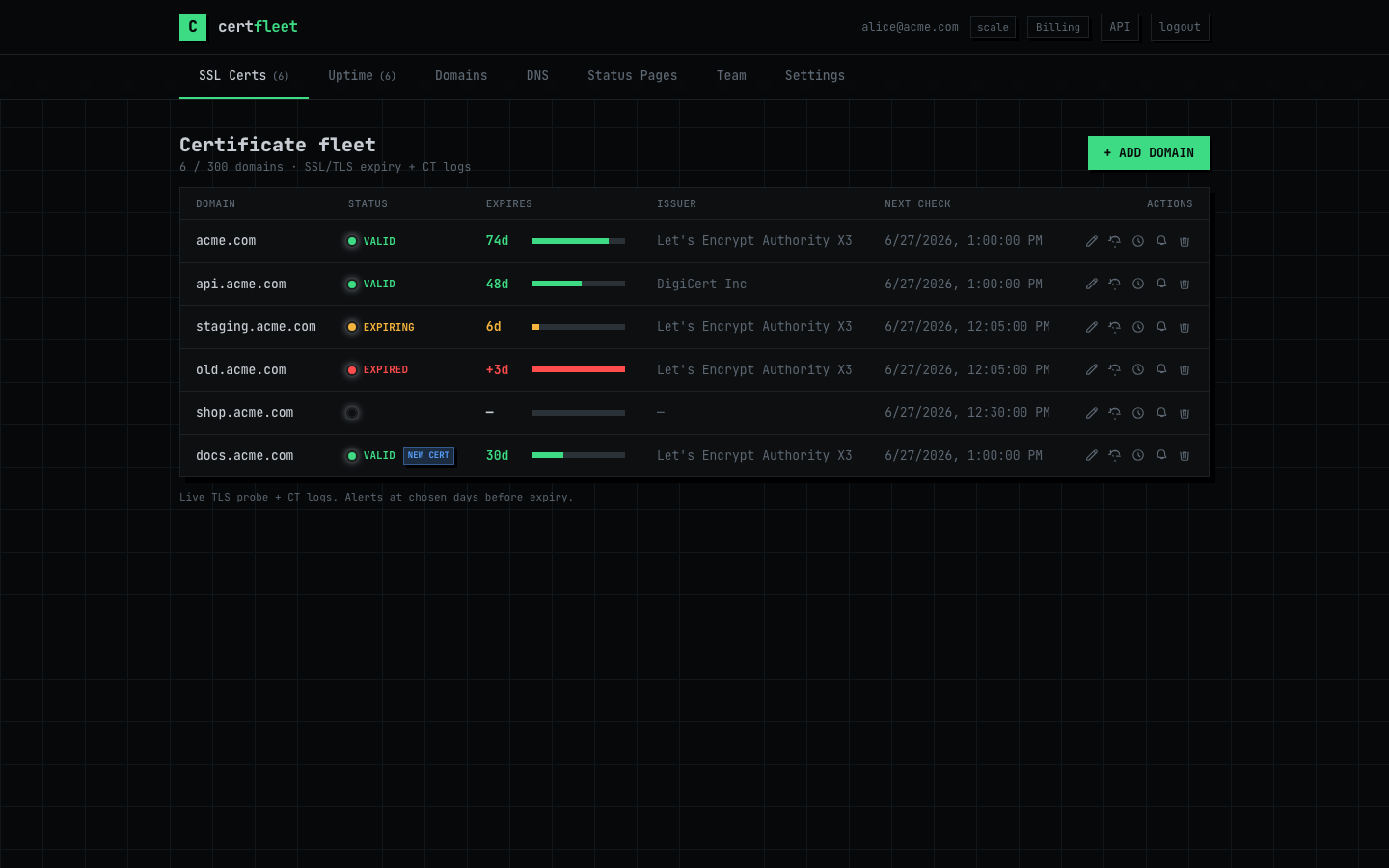
Certificate fleet sorted by expiry — every EXPIRING and EXPIRED certificate visible at a glance. Each badge corresponds to a threshold alert that has already fired on the right channel.
10 SSL certs · email + Slack · 30/14/7/1d alerts · CT monitoring.
25 certs · HMAC-signed webhooks · REST API · SMS alerts.
100 certs · team RBAC · private certs · CT new-issuance alerts · 3 users.
Configure staged SSL certificate alerts in under a minute. Free for 10 certificates with email, Slack, and CT monitoring — no credit card.
Built in France · Architecture & RGPD · All plans